 ultimate-guide
Modular Home Insurance Requirements in WA: 2026 Guide
Table of Contents
- Construction Insurance for Modular Homes: What Applies During the Build
- Transit Insurance for Relocatable Homes: Covering the Journey to Your Site
- Modular Home Building Warranty and Ongoing Cover After Handover
- Frequently Asked Questions
Last Updated: September 23, 2026
Construction Insurance for Modular Homes: What Applies During the Build
Modular home insurance protects a dwelling during the build and differs from a standard home policy because the structure is fabricated off-site. In Western Australia, requirements hinge on whether your project is residential building work and crosses the value threshold that triggers home indemnity insurance.
Modular construction splits risk across two locations: modules are fabricated in a controlled facility while your site is prepared, so a single standard policy often leaves gaps. Home indemnity insurance protects you if your builder dies, disappears, or becomes insolvent during construction or within the statutory defect period.
| Phase | Location of Risk | Primary Cover Needed |
|---|---|---|
| Off-site fabrication | Builder's facility | Builder's construction and transit cover |
| Transport to site | Road and delivery route | Transit insurance |
| On-site installation | Your block | Construction insurance |
For an experienced modular builder, coordinating these policies is routine. Capsule Builders handles the off-site phase in a structurally independent, steel-framed facility, keeping modules protected until they are ready to move.
Transit Insurance for Relocatable Homes: Covering the Journey to Your Site
Transit insurance for relocatable homes covers the modules while they are moved from the factory to your block, a phase site-built homes never face, and one of the most overlooked requirements in modular projects.
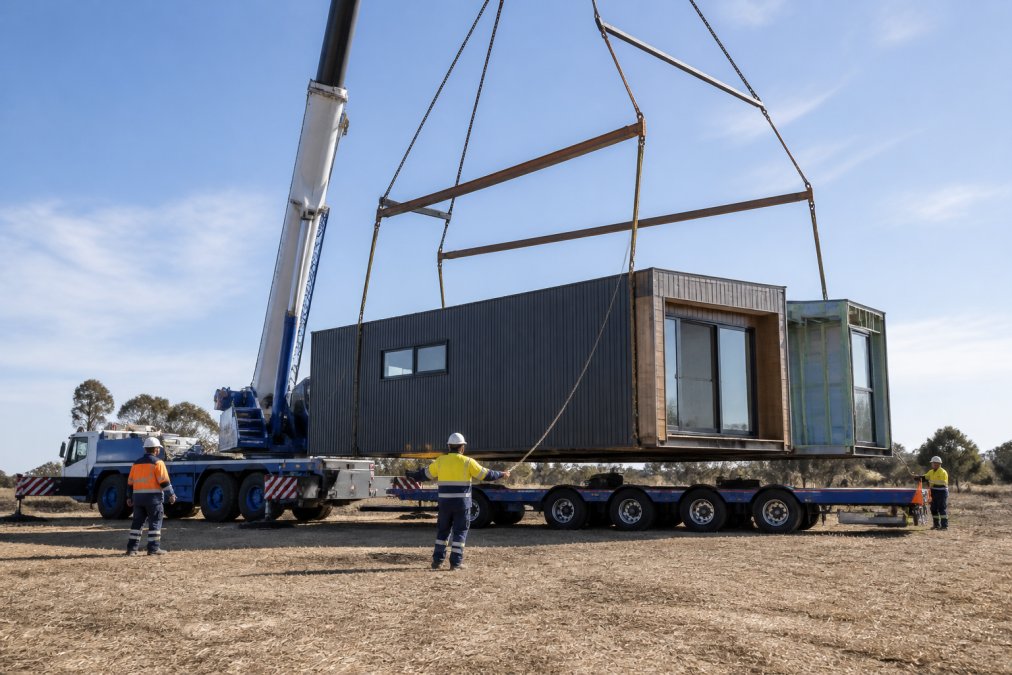
The journey involves real risk: loading, road travel, and crane unloading, and the policy must name the correct route and value. Transit and construction cover are separate policies with separate claim triggers, so a module damaged in transit may not be covered by your construction policy.
A product disclosure statement (PDS) and key facts sheet spell out exclusions, read the loading and unloading clauses specifically. For a fixed-price contract, transit obligation usually sits with the builder; for a cost plus contract it can shift to you.
Modular Home Building Warranty and Ongoing Cover After Handover
Modular home building warranty is the ongoing protection after you take the keys, and in Western Australia it centres on the statutory structural warranty period from practical completion. Once installed and certified, you need a standard building insurance policy reflecting that the dwelling sits on your land.
Insurers assess modular home insurance the same way as a site-built one for ongoing cover, provided it has the required compliance certification and building permit approvals. Your building contract should specify who lodges the permit and who holds the warranty obligation.
Building and Energy, WA Government guidance on home indemnity insurance sets out the statutory requirements that apply to residential building work, including the threshold at which home indemnity insurance becomes mandatory. Australian Building Codes Board maintains the National Construction Code that governs compliance for the completed dwelling.
For ongoing cover, compare policies on total replacement cost (not market value, to avoid underinsurance), natural disaster coverage including flood and storm damage, contents cover, liability coverage, and exclusions on structural defects versus maintenance.
A premium comparison across insurers is worth the effort, because a relocatable home can be priced differently by insurers who do not understand off-site construction. For a structural defect claim, the process starts with the structural warranty under your building contract, so keep all handover documentation.
You can build anything modular, and with an experienced modular builder coordinating permits and fabrication in parallel, the insurance sequence becomes far easier to manage. Capsule Builders specialises in custom modular builds with a 7-star minimum design target and instant R-Code compliance review.
Sorting out insurance for a modular home comes down to matching the right policy to each phase, and the gaps between phases are where owners lose money. At Capsule Builders, we specialise in custom modular builds and coordinate permits and fabrication in parallel, so your cover lines up with the construction timeline. Our Capsule Studio™ tool lets you design your home and manage your budget in real time, with instant R-Code compliance review built in.
Frequently Asked Questions
Is a modular home treated differently than a traditional home for insurance purposes?
Yes, modular homes often need specialised policies because they are built off-site and transported. Insurers may ask about the dwelling classification, compliance certification, and whether the home is fixed or relocatable. Construction insurance for modular homes typically covers off-site risks, while standard home and contents insurance applies after installation. Always check the product disclosure statement and key facts sheet for exclusions related to modular construction.
Do I need construction insurance while my modular home is being built off-site?
Construction insurance for modular homes is essential during the build phase. It covers risks like fire, theft, or damage at the factory and during on-site installation. Your builder should provide a certificate of insurance, but confirm whether it covers off-site fabrication. If you are managing the project, you may need a separate policy. Under the Home Building Contracts Act 1991, residential building work requires specific protections, so review your building contract carefully.
How does transit insurance work for modular homes?
Transit insurance for relocatable homes covers damage during transport from the factory to your site. It typically includes loading, unloading, and travel risks. Check if your builder's policy includes transit cover or if you need to arrange it. This is a gap many competitors miss, so ask for a certificate of insurance that explicitly names transit. Without it, you could face significant out-of-pocket costs for structural repairs.